
Introduction
A beautiful kitchen can still feel frustrating if the spacing is wrong. You may love the cabinets, the stone, and the lighting, but if the kitchen dimensions are off by even a few inches, everyday cooking starts to feel like a traffic jam.
That is why planning the room before choosing finishes matters so much. The right measurements help you open the dishwasher without blocking the sink, pull out drawers without bumping into the island, and move from fridge to cooktop without doing a tiny obstacle course.
Good design is not only about having a large room. A compact apartment kitchen can work beautifully when every inch has a job, while a huge kitchen can feel clumsy if the refrigerator is too far away or the island is too tight.
This guide walks through the practical measurements that make a kitchen comfortable, efficient, and safe. We will cover cabinets, counters, islands, appliances, seating, accessibility, and layouts in a way that feels useful whether you are remodeling, building new, or simply checking if your current space can work better.
What Kitchen Dimensions Really Mean
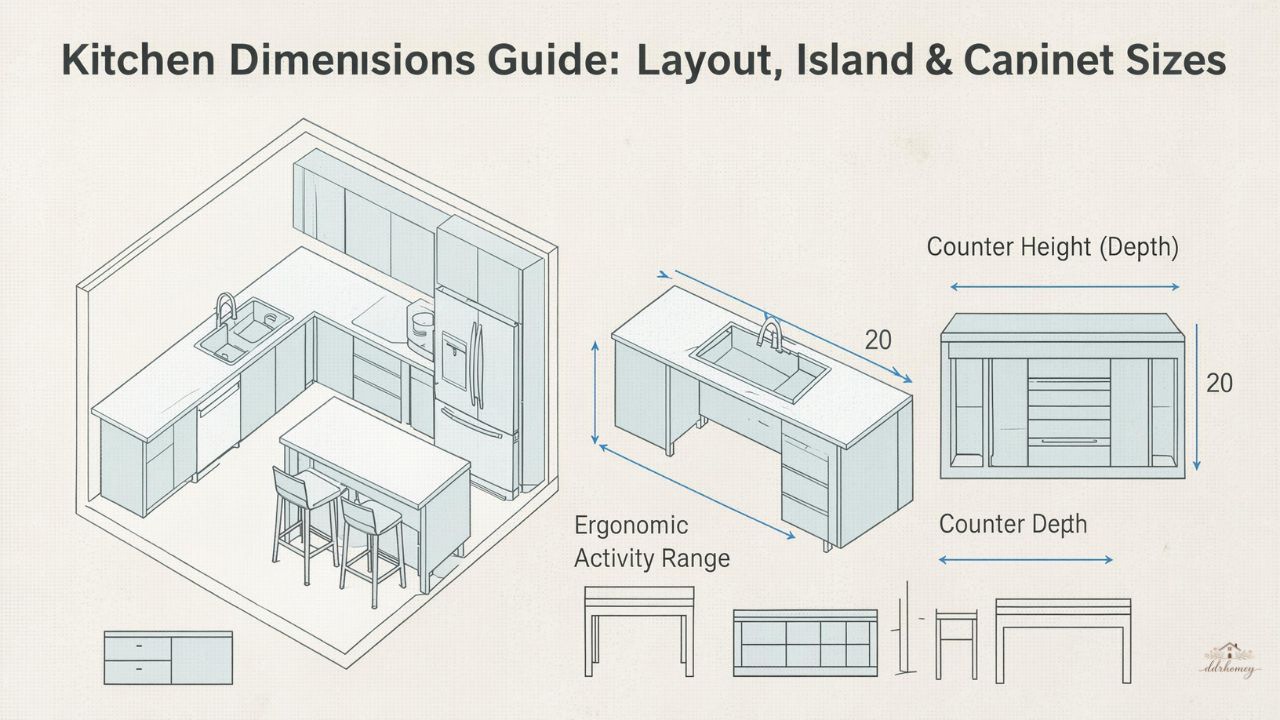
Kitchen dimensions are the planned measurements that shape how the room functions. They include the width of walkways, the depth of counters, the height of cabinets, the distance between appliances, the space around an island, and the clearances needed for drawers, doors, seating, and people.
Think of them as the invisible structure behind a kitchen that “just feels right.” When the measurements work, you do not notice them. You simply chop vegetables, unload groceries, wash dishes, and pour coffee without awkward reaching, squeezing, or sidestepping.
Why measurements matter more than square footage
Square footage tells you how much room exists, but it does not tell you whether the kitchen will work. A narrow 10-foot-by-12-foot room with smart standard kitchen measurements may function better than a larger room with an oversized island in the middle.
The most successful kitchens balance three things: movement, storage, and task comfort. You need enough room to walk, enough storage near the places where you use items, and enough counter space to prep meals without constantly clearing clutter.
Core Measurements for Everyday Comfort
Most kitchen planning starts with the basic human experience of standing, reaching, turning, opening, and walking. These numbers are not random; they reflect how people actually use the room.
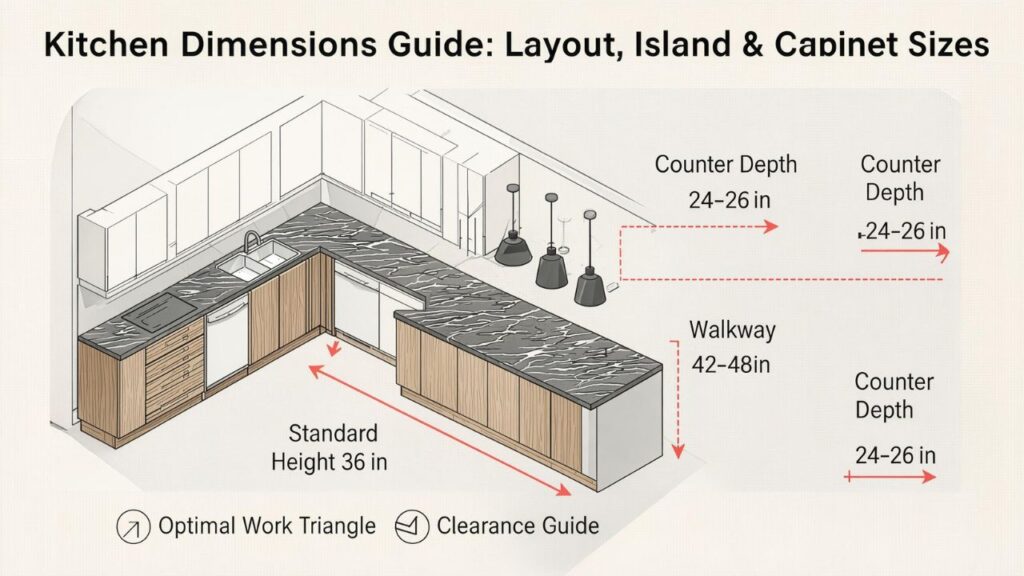
For many homes, a 36-inch walkway is treated as a comfortable minimum path, while work aisles often need more room, especially where people stand at a sink, cooktop, dishwasher, or refrigerator. NKBA-based planning guidance commonly recommends at least 42 inches for a one-cook work aisle and 48 inches for multiple cooks.
Walkways and work aisles
A walkway is a path through the kitchen. A work aisle is the space where someone actively cooks, washes, loads, unloads, or preps. That difference matters because a work aisle needs elbow room, open appliance doors, and room for another person to pass.
For a practical kitchen walkway clearance, use these targets:
- 36 inches for a basic walkway
- 42 inches for a one-cook work aisle
- 48 inches for a multi-cook work aisle
- 44 inches or more behind seating when people need to walk past comfortably
These clearances help prevent the common problem of a kitchen that photographs well but feels cramped once two people are making dinner.
Countertop height and depth
The most common kitchen countertop height is about 36 inches from the finished floor. This suits many standing prep tasks, from kneading dough to chopping vegetables, and it lines up with standard base cabinets.
Counter depth is usually about 25 to 25.5 inches, including a small overhang beyond the cabinet box. That depth gives you enough room for appliances, cutting boards, small prep zones, and backsplash clearance without forcing you to reach too far across the surface.
Landing areas beside appliances
Landing areas are small stretches of counter next to appliances. They may not sound exciting, but they make a kitchen easier to use every single day.
You want a place to set hot pans near the cooktop, groceries near the refrigerator, wet dishes near the sink, and mugs near the coffee maker. Without landing space, people start balancing items on stools, burners, windowsills, or the edge of the sink.
Cabinet, Counter, and Storage Measurements
Cabinets define the storage rhythm of the kitchen, and their sizes affect everything from appliance fit to countertop comfort. When cabinet measurements are poorly planned, the room may look finished but still waste useful space.
Standard base cabinets are often around 24 inches deep and 34.5 inches high before the countertop is added. Once the counter is installed, the finished height usually reaches about 36 inches. Wall cabinets are commonly 12 inches deep, though deeper options may be used over refrigerators or in custom designs.
Base cabinet dimensions
Base cabinets carry the countertop, sink, dishwasher, drawers, and many built-in organizers. The common depth is about 24 inches, not counting the counter overhang.
Widths vary widely. You might see 9-inch tray dividers, 12-inch pullouts, 18-inch trash units, 24-inch drawer stacks, 30-inch sink bases, 36-inch cooktop bases, and wider custom storage. The smartest approach is not to chase the biggest cabinet possible, but to choose cabinet widths that match what you will store.
Wall cabinet dimensions
Wall cabinets usually sit above the counter and store dishes, glasses, pantry items, spices, and daily essentials. A common installation leaves about 18 inches between the countertop and the bottom of the upper cabinets.
That 18-inch space gives most people enough room to work under the cabinets without feeling boxed in. It also leaves room for many small appliances, though tall blenders, espresso machines, or stand mixers may need special planning.
Tall cabinets and pantry storage
Tall cabinets are the storage towers of the kitchen. They are often used for pantry goods, brooms, ovens, microwave stacks, or integrated refrigerators.
When planning tall storage, pay attention to doors and pullouts. A tall pantry with roll-out shelves needs enough clear space in front so the shelves can extend fully and the user can stand comfortably beside them. This is where kitchen cabinet dimensions and aisle planning have to work together.
Measurements by Kitchen Layout Type
Every layout has a personality. Some are designed for speed, some for storage, some for entertaining, and some for small homes where every inch counts.
The best kitchen layout is not the one that looks most impressive on social media. It is the one that fits your room, your habits, and the number of people who use the space at the same time.
Galley kitchen
A galley kitchen uses two parallel runs of cabinets or one cabinet run facing a wall. It can be extremely efficient because the sink, cooktop, and refrigerator are close together.
For comfortable use, the aisle between the two runs usually needs to be wide enough for open doors and human movement. Around 42 inches works well for one main cook, while 48 inches is better if two people often cook together.
Galley kitchens can feel tight if too many full-depth cabinets, protruding handles, or oversized appliances compete for the same narrow aisle. Slim hardware, good lighting, and careful appliance placement can make the layout feel much more open.
L-shaped kitchen
An L-shaped kitchen uses two connected walls or cabinet runs, usually forming a natural corner. It is popular because it opens one side of the room for a table, island, or living area.
This layout often works well in small and medium homes because it keeps traffic out of the main cooking zone. If the refrigerator is at one end, the sink near the middle, and the cooktop on the other run, the room can feel balanced without forcing long walks.
The corner is the main challenge. Lazy Susans, blind-corner pullouts, diagonal cabinets, or drawer-based corner systems can help you use that space instead of creating a dark storage cave.
U-shaped kitchen
A U-shaped kitchen wraps cabinets around three sides. It can offer excellent storage and counter space, but it needs enough width so the center does not feel boxed in.
If the room is narrow, a U-shape can become crowded when cabinet doors, appliance doors, and people all compete for the same middle zone. In a wider room, it can be one of the most efficient layouts because everything is within easy reach.
A U-shaped plan is especially useful for serious home cooks who want separate prep, cooking, cleaning, and storage zones without spreading the kitchen across a large open floor plan.
Island kitchen
An island can turn a kitchen into the heart of the home, but only when the clearances are right. Poor kitchen island dimensions are one of the fastest ways to make a remodel feel disappointing.
A useful island often starts around 24 inches deep for simple storage or prep, but many islands are 36 to 48 inches deep when they include seating, a sink, appliances, or storage on both sides. Length depends on the room, but the walking space around the island matters more than the island itself.
Try not to squeeze in an island just because it is popular. A peninsula, mobile worktable, or longer counter run can sometimes give you better function with less congestion.
The Kitchen Work Triangle and Modern Work Zones
The classic kitchen work triangle connects the refrigerator, sink, and cooking surface. The idea is simple: these three points should be close enough for efficiency but not so close that people crowd each other.
Traditional planning often keeps each triangle leg roughly 4 to 9 feet long, with the total distance between the three points landing in a comfortable range. Better Homes & Gardens describes the work triangle as a useful way to reduce walking distance between the sink, refrigerator, and cooktop.
When the triangle works well
The triangle works best in smaller and medium kitchens with one main cook. It keeps the primary tasks compact: get food from the fridge, rinse or prep at the sink, then move to the cooktop.
It is especially helpful in galley, L-shaped, and U-shaped rooms. If the triangle is interrupted by an island corner, a dining table, or a major traffic path, cooking can feel less fluid.
When zones work better
Modern kitchens often need more than one triangle. Families may have one person cooking, one making coffee, one unloading the dishwasher, and another packing lunch.
That is where zones become useful. A prep zone might include knives, cutting boards, mixing bowls, and a trash pullout. A breakfast zone might include mugs, coffee, cereal, toaster, and spoons. A baking zone might include flour, measuring cups, pans, and a stand mixer lift.
Compact Kitchen Measurements That Still Feel Spacious
Small kitchens are not automatically bad kitchens. In fact, some of the most enjoyable kitchens are compact because everything is close, storage is intentional, and there is less wasted movement.
The secret is to respect compact measurements instead of fighting them. Rather than forcing a large island, oversized refrigerator, deep pantry wall, and wide range into a limited footprint, choose the features that matter most.
Make narrow spaces work harder
In a narrow kitchen, every projection matters. Handles, refrigerator doors, dishwasher doors, oven doors, and trash pullouts all need space to operate.
Consider shallower cabinets in select areas, pocket or sliding doors where appropriate, compact appliances, vertical storage, open shelves in limited doses, and drawers instead of deep lower cabinets. Drawers often make better use of lower storage because you can see the full contents without kneeling and digging.
Use light and sightlines
A small kitchen feels larger when the eye can travel. Good under-cabinet lighting, reflective surfaces, pale upper cabinets, glass doors, and open views into nearby rooms can reduce the sense of crowding.
This does not mean every small kitchen must be white. It means the layout should avoid heavy visual blocks in the wrong places. A dark lower cabinet paired with lighter uppers can look grounded without making the room feel smaller.
Appliance Clearance and Door Swing Planning
Appliances are not just boxes that fit into openings. They move, swing, vent, heat, drip, and sometimes require service access. That is why appliance clearance should be planned before cabinets are ordered.
A refrigerator may technically fit a 36-inch opening, but the doors may not open fully if it is tight against a wall. A dishwasher may fit beside a sink, but it can block the walkway when open. A range may look centered, but its oven door may collide with an island if the aisle is too narrow.
Refrigerator clearance
Refrigerators need breathing room, door swing room, and landing space. Check the manufacturer’s specifications carefully, because built-in, counter-depth, French-door, side-by-side, and column refrigerators all behave differently.
Also consider the user experience. Can someone open the fridge while another person stands at the sink? Is there a counter nearby for groceries? Can the doors open wide enough to remove drawers for cleaning?
Dishwasher clearance
The dishwasher is usually most convenient near the sink, but placement still needs care. When the dishwasher door is down, it should not trap someone at the sink or block access to frequently used drawers.
Dishes should ideally be stored nearby so unloading is quick. If plates are across the room, the kitchen creates unnecessary steps every day.
Range and cooktop clearance
Cooking areas need safe landing space, ventilation, and room for handles, pot lids, and people. Avoid placing a cooktop directly beside a tall cabinet or wall unless you have enough side clearance and heat protection.
The cooking zone also benefits from nearby drawers for utensils, potholders, spices, and pans. When these items are stored close to the range, cooking feels smoother and safer.
Seating, Islands, and Dining Clearances
Kitchen seating looks simple until people actually sit down. Knees need room, stools need room, and people passing behind seated diners need even more room.
For kitchen seating clearance, think about three layers: the overhang for knees, the space for pulling out stools, and the traffic path behind the seated person.
Counter seating measurements
A counter-height island or peninsula often uses a 36-inch-high surface. For comfortable seating, many designs use an overhang around 12 to 15 inches, depending on counter material, support, and stool style.
For width, 24 inches per seated person is a practical minimum, but 28 to 30 inches feels more comfortable for adults eating full meals. If your family uses the island daily, avoid cramming four stools where three would feel better.
Clearance behind stools
If no one needs to pass behind seated diners, the space can be tighter. If people will regularly walk behind them, plan more room.
Many design references suggest about 36 inches for someone to edge past and around 44 inches for a more comfortable walking path behind seating. NKBA-based guidance also separates tighter seating clearance from wider pass-behind traffic space.
Accessibility and Flexible Kitchen Planning
Accessible design is not only for wheelchair users. It helps children, older adults, injured family members, and anyone who wants a kitchen that is easier to use over time.
Official accessibility guidance often uses clear floor space, knee clearance, turning space, reach ranges, and lower work surfaces to make kitchens usable for more people. The U.S. Access Board describes knee and toe space as at least 30 inches wide, with depth rules that support forward approach in accessible spaces.
Flexible counter heights
While 36 inches is common for standard counters, a lower section can be helpful for seated prep, baking, children, or accessible use. In accessible kitchens, work surfaces are often lower, with space underneath for knees and toes.
Even in a non-accessible remodel, mixed-height planning can make the kitchen more comfortable. A baking area, desk niche, or seated prep counter can add flexibility without changing the whole kitchen.
Clear turning space
A kitchen with generous clear floor area is easier for everyone. It helps with wheelchairs, walkers, strollers, laundry baskets, pet bowls, and two people moving at once.
If long-term living is part of your plan, think beyond today’s habits. Wider aisles, drawer storage, pull-down shelves, easy-grip hardware, and good lighting can make the room more forgiving for years to come.
Common Kitchen Dimension Mistakes
Most kitchen mistakes are not dramatic. They are small measurement problems repeated daily until they become annoying.
One of the biggest mistakes is choosing an island before confirming aisle space. Another is placing the refrigerator in a corner where the doors cannot open fully. A third is forgetting that drawers, dishwashers, ovens, and people all need space at the same time.
Oversized islands
An island should improve movement, not interrupt it. If the island forces people to squeeze around corners or blocks the dishwasher, it is too large or in the wrong place.
Sometimes a slimmer island is better. Sometimes a peninsula is better. Sometimes the best choice is no island at all.
Poor storage placement
Storage should live near the task it supports. Pots belong near the cooking zone, plates near the dishwasher, knives near prep space, mugs near the coffee area, and trash near the sink or prep counter.
When storage is placed only for symmetry, daily use suffers. A perfectly balanced cabinet wall may look nice, but if the cereal is far from bowls and spoons, the layout is working against you.
Ignoring real-life habits
A kitchen for a solo cook is different from a kitchen for a family of five. A kitchen for frequent baking is different from a kitchen for quick breakfasts and takeout plating.
Before finalizing kitchen dimensions, walk through a normal day. Where do groceries land? Who empties the dishwasher? Where does the dog sit? Where do kids do homework? Where do guests stand when you are cooking?
How to Measure Your Kitchen Before Remodeling
Measuring sounds simple, but accuracy at this stage saves money later. Take your time and measure more than once.
Start with the room’s total length and width. Then measure windows, doors, ceiling height, wall breaks, columns, soffits, radiators, vents, plumbing locations, electrical outlets, switches, and any architectural details that affect cabinet placement.
Create a simple measurement checklist
Use this basic checklist before meeting a designer, contractor, or cabinet supplier:
- Overall room length and width
- Ceiling height
- Window size and distance from floor
- Door widths and swing direction
- Existing appliance sizes
- Plumbing and gas locations
- Electrical outlets and switches
- Ventilation route
- Wall thickness if openings are changing
- Floor transitions into nearby rooms
Photos and videos help too. A slow video walk-through can remind you of details that a sketch may miss.
Mark movement zones on the floor
Painter’s tape is one of the cheapest planning tools you can use. Tape out the island, cabinet runs, table, or pantry wall on the floor.
Then move through the room. Pretend to open the oven. Pretend to unload the dishwasher. Stand where someone would sit at the island. These small tests reveal problems that drawings sometimes hide.
FAQ
What are the standard kitchen dimensions for a comfortable layout?
A comfortable kitchen usually includes 36-inch walkways, 42-inch work aisles for one cook, and 48-inch work aisles for multiple cooks. Counters are commonly about 36 inches high, and base cabinets are usually about 24 inches deep before the countertop overhang.
How much space should be between kitchen cabinets and an island?
For most homes, plan about 42 inches between cabinets and an island if one person usually cooks. Use about 48 inches when two people cook together or when appliance doors open into that aisle.
What is the minimum size for a kitchen island?
A small fixed island may be around 24 inches deep and 36 inches wide, but that only works when the surrounding walkways remain comfortable. The room around the island matters more than the island’s footprint.
How wide should a kitchen walkway be?
A basic walkway should generally be about 36 inches wide. In active work zones, 42 to 48 inches is often more comfortable, especially near the sink, stove, dishwasher, or refrigerator.
What is the best counter height for a kitchen?
The most common kitchen counter height is about 36 inches. Some homes include lower or higher sections for baking, seated prep, accessibility, or personal comfort.
How much room do you need behind island seating?
If no one walks behind the stools, the clearance can be modest. If people need to pass behind seated diners, plan roughly 36 inches for edging past and closer to 44 inches for comfortable walking.
Are small kitchens better with an island or peninsula?
Many small kitchens work better with a peninsula, mobile cart, or uninterrupted counter run instead of a fixed island. The best choice depends on aisle width, appliance doors, storage needs, and how people move through the room.
What kitchen measurements should I check before ordering cabinets?
Check the total room size, ceiling height, appliance openings, window and door positions, plumbing, electrical outlets, ventilation, floor transitions, and every required clearance for doors, drawers, and walkways.
Conclusion
A kitchen becomes easier to love when the measurements support real life. The right clearances let people cook together, open appliances fully, sit comfortably, store things where they belong, and move through the room without constant frustration.
Before falling for a cabinet color, countertop slab, or oversized island, spend time with the plan. Measure the room, tape out the major pieces, check appliance doors, and imagine a busy morning or a full dinner prep. When the kitchen dimensions fit the way you actually live, the whole room feels calmer, smarter, and far more enjoyable.