There’s a moment every person knows. You sit down in someone else’s living room, sink into their chair, and think — why doesn’t my chair feel like this?
Finding truly comfortable chairs isn’t as simple as picking something that looks good in a showroom. It’s about understanding how your body interacts with a seat over hours, not minutes. It’s about the angle of the backrest, the depth of the cushion, the height of the armrests, and the material wrapped around the frame.
This guide covers everything — from room chair design philosophy to the science of lounge chair seat back angle comfort, from unique accent chairs that become the focal point of a room to bedroom sofa chairs that make early mornings feel less brutal. Whether you’re searching for the best lounge chair for long reading sessions or trying to nail a cohesive sofa chair design for your living room, this is the resource you need.
Why Comfort in a Chair Is More Complicated Than You Think
Most people buy chairs based on looks. That’s understandable — a stunning designer chair can anchor a room’s entire aesthetic. But looks without ergonomic thought can leave you shifting, slouching, or standing up after 20 minutes because your lower back is screaming.
Real comfort in lounge chairs comes down to a few core principles:
- Seat depth: Too shallow and your thighs aren’t supported. Too deep and you’re either slumped or perching on the edge.
- Seat height: Your feet should rest naturally on the floor. If they dangle, blood circulation gets compromised.
- Lumbar support: The lower spine has a natural inward curve. A good comfortable armchair respects that.
- Armrest height: Armrests set too high force your shoulders upward. Too low and you lose lateral support.
These aren’t nitpicks. They’re the difference between a chair you love for a decade and one you avoid.
Understanding Lounge Chair Angles (The Science Behind the Sit)
Here’s something most furniture brands don’t advertise clearly: lounge chair angles matter more than cushion thickness.
The lounge chair seat back angle comfort sweet spot sits somewhere between 100° and 115° from the seat base. Sit at 90° (perfectly upright) for extended periods and you’re actually creating more spinal compression than a slight recline. Research in ergonomics consistently shows that a slightly reclined lounge chair position reduces disc pressure and muscular strain in the lower back.
The classic lounge chair seat back angle comfort design — perfected by icons like the Eames Lounge Chair — uses approximately a 101° recline angle. It’s not dramatic enough to make you feel like you’re lying down, but it’s far more restorative than sitting bolt upright.
For reference, here’s how lounge chair angles break down by purpose:
| Lounge Chair Angle | Best Use Case |
|---|---|
| 90°–95° | Active seating, task chairs, dining |
| 100°–110° | Reading, conversation, relaxed lounging |
| 115°–130° | TV watching, napping, deep relaxation |
| 130°+ | Full recliners, chaise lounges |
Understanding this before you shop prevents a lot of expensive regret.
Types of Lounge Chairs: A Practical Breakdown
The term “lounge chair” covers a lot of ground. Here’s a breakdown of the main types of lounge chairs you’ll encounter, what makes each distinct, and where they work best.
1. Club Chairs
The classic club chair traces its roots to British gentlemen’s clubs of the 19th century. Wide arms, a deep seat, and substantial cushioning define this style. Famous chairs in this category include the Chesterfield club chair — a silhouette so recognizable it’s become a design archetype.
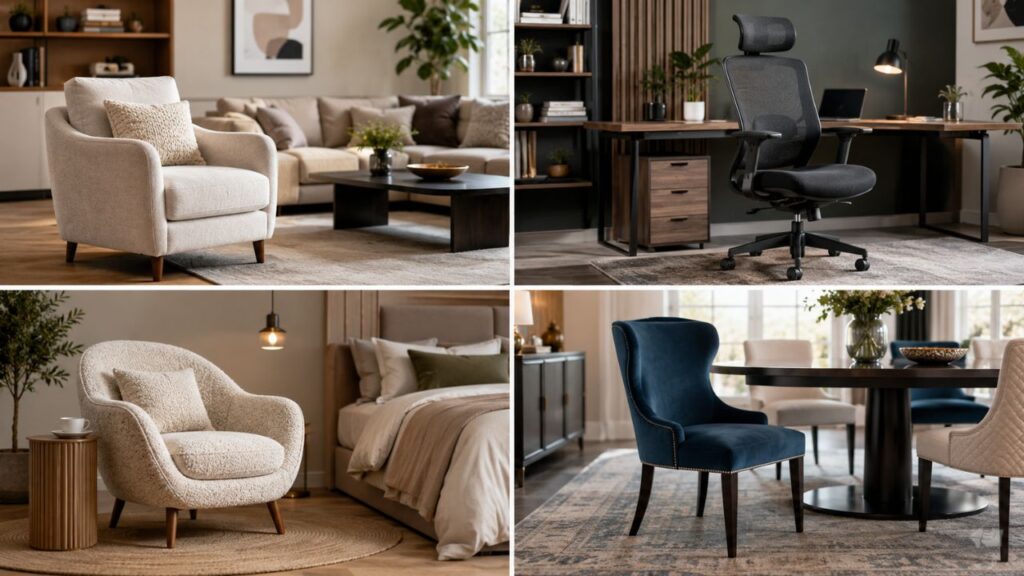
Modern versions make excellent comfortable chairs for living room use. They hold their shape well and accommodate a wide range of body types.
2. Barrel Chairs
Named for their rounded back that wraps slightly forward, barrel chairs create a sense of enclosure that many people find psychologically cozy. They work well as room chairs in smaller spaces where a full sofa isn’t practical.
3. Slipper Chairs
Low to the ground, legless or nearly so, slipper chairs are elegant and compact. They’re a popular choice as a bedroom chair design element — tucked into a corner or placed at the foot of a bed.
4. Chaise Lounges / Long Chair Designs
If you want to fully stretch out, a long chair design like a chaise lounge is unbeatable. A comfortable lounge chair of this style doubles as a napping spot and reading nook. The lounge seat extends to support the full length of the legs, which is something no standard armchair can do.
5. Wingback Chairs
The high wings on either side of the back were originally designed to trap heat from a fireplace and block drafts. Today they serve as an aesthetic signature — stately, traditional, and surprisingly cozy.
6. Swivel Chairs
Modern lounge chairs in swivel styles add functionality to comfort. Rotating 360° lets you engage with different parts of a room without getting up — useful in open-plan living spaces.
Best Accent Chairs: Style With Substance
Accent chairs are supposed to do two things simultaneously: make a visual statement and actually be comfortable to sit in. The tension between those goals is real.
The best accent chairs manage it by prioritizing silhouette over ornamentation. A bold fabric or an unusual leg design does the visual work without compromising the seating structure underneath.
Unique accent chairs tend to succeed when they:
- Use a distinctive material (velvet, boucle, rattan) on an otherwise conventional frame
- Feature an unexpected color in an otherwise neutral room
- Play with scale — either larger or smaller than expected
Some of the most iconic designer chairs in history started as accent pieces. The Tulip Chair by Eero Saarinen, the Egg Chair by Arne Jacobsen, and the Ghost Chair by Philippe Starck are all technically accent chairs that happen to be extraordinarily comfortable.
When you’re shopping for best accent chairs, try sitting in them for at least five minutes before buying. A chair that photographs beautifully but makes your back hurt after two minutes isn’t doing its job.
Comfortable Chairs for Living Room: Getting It Right
The living room is where most people spend the majority of their sitting time at home, so comfortable chairs for living room spaces deserve serious thought.
The mistake most people make is buying a chair that matches the sofa perfectly but creates an awkward conversation setup. Room chair design in a living room should consider:
Conversation distance: Seats positioned more than 3 meters apart make natural conversation difficult. If your room is large, grouping chairs closer together creates a more intimate seating area.
Traffic flow: A comfortable chair for living room use shouldn’t block pathways. Leave at least 90cm of walking space around it.
Scale: A petite chair in a large room disappears visually. A massive oversized chair in a small room suffocates the space. Match the scale of your room chairs to the room’s proportions.
The 60-30-10 rule: In interior design, 60% of a room’s color should be dominant (walls, sofa), 30% secondary (rugs, curtains), and 10% accent. Your accent chairs occupy that 10% — so don’t be afraid to go bold.
Some of the best lounge chairs for living rooms right now include models from brands like West Elm, Article, Crate & Barrel, and Restoration Hardware. For higher-end designer lounge chairs, names like Herman Miller, Knoll, and Cassina consistently produce pieces that hold up aesthetically and structurally for decades.
Bedroom Chair Design: Often Overlooked, Always Worth It
A bedroom sofa chair or a compact bedroom chair design is one of those additions people overlook until they have one — and then wonder how they lived without it.
The primary functions of a bedroom sofa chair are:
- A spot to pull on shoes without sitting on the bed
- A reading perch away from screens
- A place to throw tomorrow’s outfit (let’s be honest)
- Visual warmth in a room that might otherwise feel sparse
Bedroom chair design tends toward the smaller, quieter end of the spectrum. Slipper chairs, small armchairs, and petite leisure chairs all work well. The key is choosing something that doesn’t compete with the bed as the room’s focal point.
For bedroom sofa chair options, look for pieces with:
- A narrower profile (under 70cm wide is usually ideal for bedrooms)
- Fabric that’s soft to the touch, since you may be sitting in it barefoot or in pajamas
- A leg height that makes it easy to get in and out of, especially first thing in the morning
Modern Lounge Chairs: What’s Actually Worth Buying in 2026
Modern lounge chairs have evolved significantly over the last decade. The aesthetic has moved away from the minimalist coldness of early-2000s modernism toward something warmer — organic shapes, natural materials, and colors that feel lived-in rather than showroom-fresh.
Current trends in modern lounge chair design include:
Curved forms: Soft, rounded silhouettes dominate. The angular hard lines of mid-century knockoffs have given way to chairs that look like they grew organically.
Boucle fabric: This looped, textured wool-blend material has become ubiquitous for good reason. It photographs beautifully, feels warm to the touch, and hides everyday wear better than smooth fabrics.
Swivel bases: A modern lounge chair on a swivel base offers significantly more versatility than a static four-legged version, especially in open-plan homes.
Natural wood frames: Walnut and oak legs add warmth without visual weight. They pair with almost any color palette and age gracefully.
Designer lounge chairs from brands like Muuto, HAY, Menu, and Ferm Living have found a strong following among design-conscious consumers who want quality without the museum-piece price tag of heritage brands.
Leisure Chairs and the Art of Doing Nothing Productively
The leisure chair is a slightly underused concept in Western interiors — but cultures with strong traditions of afternoon rest have understood it for centuries.
A leisure chair is specifically designed for passive activities: thinking, reading, listening to music, watching the garden. It’s not a task chair. It’s not a dining chair. It’s a chair that gives your body permission to rest completely while keeping you alert enough not to fall asleep (unless you want to).
The best leisure chairs share a few traits: enough recline to decompress the spine, armrests at the right height to let your shoulders drop, and a seat depth that lets you shift position easily over an extended session.
If your home doesn’t have a leisure chair, you’re missing something. Even in small spaces, a compact comfortable lounge chair tucked into a corner can become the most-used seat in the house.
Famous Chairs Worth Knowing About
If you’re serious about understanding what makes a comfortable chair exceptional, studying the famous chairs in design history is genuinely useful — not just as aesthetic inspiration, but as education in what actually works.
Eames Lounge Chair (1956): Designed by Charles and Ray Eames for Herman Miller, this is probably the most recognizable designer lounge chair in history. The molded plywood shell and leather upholstery created a lounge chair seat back angle comfort solution that’s still unmatched for long reading sessions.
Barcelona Chair (1929): Ludwig Mies van der Rohe designed this for the German Pavilion at the International Exposition. It’s one of the most visually striking designer chairs ever made — though comfort is secondary to its visual authority.
Egg Chair (1958): Arne Jacobsen’s sculptural masterpiece for the SAS Royal Hotel in Copenhagen wraps the sitter in a cocoon of upholstery. It remains one of the most imitated unique accent chairs in contemporary furniture.
Swan Chair (1958): Also by Jacobsen, the Swan is a more open version of the Egg — excellent as an accent chair in residential settings.
Panton Chair (1967): Verner Panton created the first single-form injection-molded plastic chair. Its S-curve form makes it one of the most recognizable room chairs of the 20th century.
These famous chairs aren’t just historically significant — they solve real problems in interesting ways. Studying them teaches you what to look for in any chair you consider buying.
Sofa Chair Design: When One Seat Does It All
The sofa chair design — sometimes called a chair-and-a-half — occupies the space between a standard armchair and a two-seat sofa. It’s wide enough for one person to curl up sideways, but not so large it dominates a room.
A good sofa chair design suits:
- Solo dwellers who want maximum personal comfort
- Readers who like curling their legs up
- Living rooms that need flexible seating without a second full sofa
The best sofa chair design options maintain the visual lightness of a chair while offering the generous proportions of a small sofa. Look for frames between 90–110cm wide — wide enough to curl up in, narrow enough to fit sensibly in most room configurations.
How to Actually Choose the Right Comfortable Chair
Here’s a practical framework for making a decision you won’t regret:
Step 1: Define the primary use. Reading? Socializing? Napping? The intended activity should drive everything else — including lounge chair angles, depth, and material.
Step 2: Measure your space before falling in love with anything. Add at least 45cm clearance on each side, 90cm in front for a footstool if you want one.
Step 3: Sit in it for at least five minutes. Showroom chairs always feel good for the first 30 seconds. Push past that and notice what starts to bother you.
Step 4: Consider the fabric honestly. If you have kids, pets, or you eat while sitting, performance fabrics are worth the trade-off in texture.
Step 5: Think about longevity. A solid hardwood frame with replaceable cushions will outlast a particle-board frame with integrated foam by 15 years.
Step 6: Match the scale. A large chair in a small room will make both look worse. A small chair in a large room will look lost and cheap.
Comparison: Best Lounge Chairs by Category
| Category | Best For | Key Feature |
|---|---|---|
| Club Chair | Long conversations, reading | Deep seat, wide arms |
| Chaise Lounge | Full body rest, long chair design | Extended leg support |
| Barrel Chair | Small rooms, cozy aesthetic | Wrapped back |
| Wingback Chair | Traditional rooms, statement look | High back wings |
| Slipper Chair | Bedrooms, tight spaces | Low profile, compact |
| Modern Swivel Chair | Open-plan spaces | 360° rotation |
| Chair-and-a-Half | Solo comfort, reading nooks | Extra width |
FAQ: Comfortable Chairs
Q: What makes a lounge chair actually comfortable for long periods? The most important factors are the lounge chair seat back angle comfort (between 100°–115° is optimal), adequate lumbar support, and seat depth that matches your leg length. Cushion quality matters, but structure matters more.
Q: What’s the difference between accent chairs and lounge chairs? Accent chairs are defined primarily by their visual role in a room — they’re meant to stand out. Lounge chairs are defined by their function — extended, relaxed sitting. The best pieces are both simultaneously.
Q: How do I choose a bedroom chair design that doesn’t look out of place? Keep the bedroom chair design quieter than your living room choices. Neutral fabrics, compact proportions, and legs that coordinate with your bed frame tend to integrate well without competing.
Q: Are expensive designer chairs actually more comfortable? Not automatically. Many famous chairs are celebrated for their aesthetic contribution rather than ergonomic innovation. The Eames Lounge Chair is a genuine exception — it’s both beautiful and ergonomically considered. Research specific models rather than trusting price as a proxy for comfort.
Q: What’s a leisure chair and do I actually need one? A leisure chair is any seating piece specifically intended for passive rest — reading, thinking, listening. You don’t need one, but once you have a dedicated comfortable lounge chair in your home that serves only this purpose, you’ll understand why people who have them never give them up.
Q: What’s the best lounge chair for small apartments? Look for chairs with visual lightness — thin exposed legs, open arms, or a swivel base. Slipper chairs and compact barrel chairs work well in tight spaces. The best lounge chairs for small rooms often have a higher seat height, which makes the room feel taller.
Q: How do I choose unique accent chairs without making my room look chaotic? Pick unique accent chairs that share at least one element with the rest of the room — a color from the rug, a material from the curtains, or a leg finish that matches the coffee table. That single point of connection lets everything else be different without the room falling apart visually.