Introduction
A kitchen can look beautiful and still feel annoying when the little daily tasks are harder than they need to be. That is where a pot filler gets people curious.
It sits near the stove and lets you fill large pots right where you cook, instead of carrying heavy water from the sink. For people who make pasta, soups, rice, stock, tea, or big family meals often, that small detail can feel surprisingly helpful.
Still, this is not a must-have for every kitchen. A pot filler adds plumbing, cost, cleaning, and one more water source above your cooking area. So the real question is not just whether it looks good. The better question is whether it fits the way you cook, clean, and use your kitchen every day.
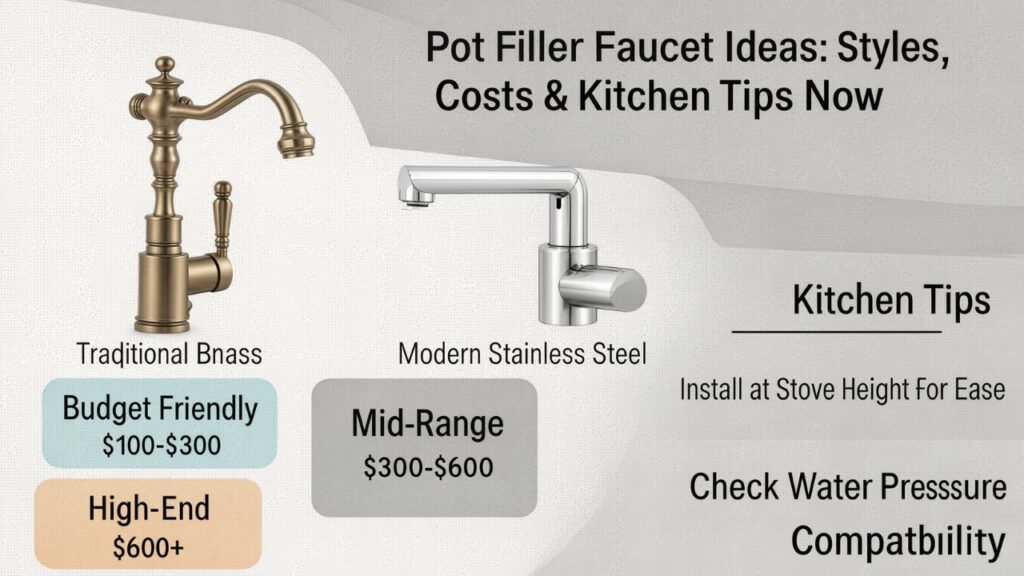
Table of Contents
- What Is a Pot Filler?
- Why Homeowners Add a Pot Filler
- Best Kitchen Layouts for a Pot Filler
- Wall-Mounted vs Deck-Mounted Designs
- Best Finishes and Styles
- Placement and Height Tips
- Installation and Plumbing Considerations
- Cost Factors to Know
- Pros and Cons
- Cleaning and Maintenance Tips
- Common Mistakes to Avoid
- FAQs
- Conclusion
What Is a Pot Filler?
A pot filler is a secondary kitchen faucet installed near a stove, cooktop, or range. Its main job is simple: fill pots with water directly at the cooking area.
Most designs have a folding or swing-out arm, so the faucet can reach over different burners and fold back against the wall when not in use. Some are mounted on the wall behind the range, while others are installed on the countertop near the cooktop.
Design sources commonly describe it as a faucet placed by the stove to reduce the need to carry heavy water-filled pots from the sink to the cooking area. Many models also have articulated arms for easier reach.
Why It Feels Like a Luxury Feature
A pot filler has become a popular “dream kitchen” detail because it looks professional. You often see it in chef-style kitchens, high-end remodels, farmhouse kitchens, and social media kitchen tours.
But it is not only decorative. If you cook large meals regularly, it can save effort. If you rarely boil water or mostly cook quick meals, it may be more of a style feature than a daily need.
Why Homeowners Add a Pot Filler
The biggest reason people add one is convenience. Carrying a large pot full of water across the kitchen can be awkward, especially if the sink and stove are far apart.
A gallon of water weighs about 8.34 pounds. A large stockpot can quickly become heavy before it even reaches the stove. For older adults, busy parents, frequent hosts, or anyone with wrist, back, or shoulder discomfort, reducing that lifting can feel meaningful.
It Helps With Big-Batch Cooking
This feature is especially useful if you often cook:
- Pasta
- Rice
- Soups
- Broths
- Seafood boils
- Large tea kettles
- Stews
- Canning recipes
- Family-size meals
- Restaurant-style prep at home
It Adds a Designer Look
A well-placed faucet above the stove can make a backsplash feel finished. Brass, matte black, polished nickel, chrome, and stainless steel all create different moods.
That said, the feature should not look random. It should match the kitchen’s faucet style, cabinet hardware, lighting, and overall design language.
Best Kitchen Layouts for a Pot Filler
Not every kitchen needs one. The layout matters.
Large Kitchens
Large kitchens benefit most because the sink and stove may be far apart. If the cooking zone is across an island or on a separate wall, a stove-side water source can be genuinely useful.
Kitchens With Large Ranges
A 36-inch or 48-inch range often becomes a focal point. A wall-mounted faucet above it can balance the backsplash and make the range area feel complete.
Open-Concept Kitchens
In open kitchens, the range wall is often highly visible. A beautiful fixture can add detail without taking counter space.
Small Kitchens
A small kitchen may not need this feature if the sink is only a step away. However, it can still work if you cook often and have the plumbing access.
Butler’s Pantry or Secondary Cooking Area
Some homeowners use one in a prep kitchen, scullery, or secondary cooking zone where large pots, kettles, or serving containers are filled.
Wall-Mounted vs Deck-Mounted Designs
There are two main installation styles: wall-mounted and deck-mounted.
Wall-Mounted Pot Filler
A wall-mounted design is installed on the backsplash behind or beside the stove. This is the classic look most people imagine.
It works best when:
- The wall behind the range can accept plumbing
- The backsplash is being installed or replaced
- The faucet can be centered nicely over the cooking area
- The wall structure allows secure mounting
Deck-Mounted Pot Filler
A deck-mounted design is installed on the countertop beside or behind the cooktop.
It works best when:
- Wall plumbing is difficult
- The cooktop is on an island
- You want the faucet lower and closer to the counter
- The backsplash area is not suitable
Quick Comparison
| Feature | Wall-Mounted | Deck-Mounted |
|---|---|---|
| Visual style | Classic and dramatic | Subtle and practical |
| Best location | Range wall | Island or counter cooktop |
| Plumbing access | Inside wall | Through countertop/cabinet |
| Cleaning | Backsplash area needs wiping | Counter area needs wiping |
| Design impact | Strong focal point | More understated |
Best Finishes and Styles
The finish can make the fixture blend in or stand out.
Brass
Brass feels warm, elegant, and slightly vintage. It works well with white tile, marble, dark cabinets, green cabinets, and warm wood.
Matte Black
Matte black gives a bold modern or farmhouse look. It pairs well with black cabinet pulls, black lighting, and white subway tile.
Chrome
Chrome is bright, clean, and usually budget-friendly. It suits simple modern kitchens and classic white kitchens.
Polished Nickel
Polished nickel feels softer and warmer than chrome. It is a beautiful option for traditional, transitional, and luxury kitchens.
Stainless Steel
Stainless steel works nicely with stainless ranges, professional appliances, and modern kitchens.
Oil-Rubbed Bronze
This finish suits rustic, old-world, Tuscan, or traditional kitchens, though it can feel heavy in very small spaces.
Placement and Height Tips
Placement is where many homeowners get nervous, and for good reason. A beautiful fixture installed at the wrong height can become awkward.
A commonly suggested placement range is around 16 to 24 inches above the cooking surface, depending on the faucet reach, pot height, backsplash layout, and appliance clearance. Some design guides also discuss this range when explaining stove-side faucet planning.
Center It Carefully
Most people center the faucet over the range or cooktop. This looks balanced, especially with a range hood above.
However, if burner layout or wall studs make exact centering difficult, function should come first.
Check the Arm Reach
Before installing, confirm the faucet arm reaches the burners you use most. It should reach comfortably over large pots without forcing the arm into an odd angle.
Leave Room for Tall Pots
The faucet should be high enough to clear your largest stockpot. If you use tall canning pots or deep soup pots, measure them before finalizing height.
Avoid Heat Conflicts
The fixture should not sit too low over high heat. Follow manufacturer instructions and ask your plumber or installer to review appliance clearances.
Installation and Plumbing Considerations
A pot filler usually needs a cold-water supply line. That line must be routed to the stove wall or cooktop area.
This is why installation is easiest during a remodel, before drywall, tile, and backsplash are finished. Retrofitting one into a finished kitchen can be possible, but it may require opening walls, removing tile, or accessing plumbing from behind.
Use a Licensed Plumber
This is not a place to guess. A water line above a stove must be properly installed, tested, and shut off. Poor installation can create leaks behind finished walls or backsplash tile.
HomeAdvisor notes that a standard kitchen faucet installation averages about $262, with many homeowners paying between $162 and $364, while plumbers may charge hourly depending on the work. A stove-side faucet can cost more when new plumbing lines or wall work are needed.
Ask About Shutoff Access
A shutoff valve is important because this fixture is not over a drain. If anything leaks, you want a way to stop water quickly.
Some designs include dual shutoffs, such as one at the wall and one at the spout. Your plumber can explain what is appropriate for your home and local code.
Check Local Rules
Plumbing rules vary by location. Your installer may need to consider permits, backflow protection, shutoff requirements, and manufacturer instructions.
The safest path is to treat it as real plumbing, not just a decorative kitchen accessory.
Cost Factors to Know
The cost depends on the fixture, finish, plumbing access, backsplash work, labor, and whether the kitchen is already under renovation.
Angi reports plumber labor commonly ranges from $45 to $200 per hour for this type of installation, and notes that hiring a plumber helps reduce the risk of later plumbing problems.
Main Cost Factors
| Cost Factor | Why It Matters |
|---|---|
| Fixture price | Basic models cost less than luxury designer options |
| Finish | Brass, nickel, and custom finishes may cost more |
| Plumbing access | Open walls are easier than finished walls |
| Backsplash work | Tile removal and repair adds labor |
| Wall material | Stone, tile, and plaster can complicate work |
| Permit needs | Some areas may require plumbing permits |
| Labor rates | Costs vary by region and contractor |
| Remodel timing | Installing during renovation is usually easier |
Where to Spend More
Spend more on a reliable fixture, quality valves, skilled plumbing, and careful installation.
Where to Save
You can save by choosing a simple finish, installing during a kitchen remodel, using standard placement, and avoiding unnecessary wall changes.
Pros and Cons
A pot filler can be wonderful for some kitchens and unnecessary for others.
Pros
- Reduces carrying heavy water-filled pots
- Adds a professional kitchen look
- Helps with big-batch cooking
- Can fill kettles, stockpots, and large containers
- Works beautifully as a range wall focal point
- Adds convenience when the sink is far from the stove
Delta lists common advantages such as faster filling, an extra water source, and a professional look, while also noting that extra water-line installation is a drawback.
Cons
- Adds plumbing cost
- Has no drain beneath it
- Creates another fixture to clean
- Can leak if poorly installed or ignored
- May be unnecessary in small kitchens
- Still does not help you drain hot water after cooking
Hansgrohe also points out a major limitation: the faucet fills pots, but there is no drain at the stove, so spills can be harder to manage and pasta water still has to be carried back to the sink.
Infographic: Pot Filler Planning Checklist
Pot Filler Planning Checklist
- Measure your tallest pot
- Check stove and hood clearance
- Confirm faucet reach
- Plan cold-water plumbing
- Add accessible shutoff control
- Match finish with kitchen hardware
- Install before backsplash when possible
- Clean regularly to prevent grease buildup
Design Ideas for Different Kitchens
Modern Kitchen
Choose a simple chrome, stainless, or matte black fixture with clean lines. Pair it with slab cabinets, quartz counters, and a minimal backsplash.
Farmhouse Kitchen
Use aged brass, polished nickel, or matte black. Pair it with shaker cabinets, apron-front sink, warm wood shelves, and handmade-style tile.
Luxury Kitchen
Use unlacquered brass, polished nickel, or a designer bridge-style faucet. Pair it with marble slab backsplash, custom range hood, and panel-ready appliances.
Small Kitchen
Keep the design simple. A compact faucet in chrome or stainless can add function without making the wall feel crowded.
Industrial Kitchen
Choose matte black or stainless steel. Pair it with concrete counters, metal shelving, dark grout, and exposed-style lighting.
Best Backsplash Pairings
The backsplash sits directly behind the fixture, so it matters.
Subway Tile
Classic, affordable, and easy to pair with almost any finish.
Marble Slab
Elegant and seamless. It makes the fixture look more custom.
Zellige Tile
Adds handmade texture and warmth. Looks beautiful with brass or nickel.
Porcelain Slab
Durable, clean, and easier to maintain than some natural stones.
Stone Tile
Works well in rustic or traditional kitchens but may need sealing.
Cleaning and Maintenance Tips
A stove-side faucet lives in a greasy zone. Even if you do not use it daily, it will collect cooking residue.
Wipe It Weekly
Use a soft cloth and gentle cleaner. Avoid harsh abrasives, especially on brass, matte black, or specialty finishes.
Move the Arms Occasionally
Fold and unfold the arms so joints do not become stiff. This also helps you notice drips early.
Watch for Leaks
Look for water around the wall plate, spout, joints, or shutoff. Even a small drip should be checked quickly.
Clean the Backsplash
Grease can build up behind the fixture. Choose backsplash materials that are easy to wipe.
Follow Finish Care Instructions
Some living finishes, such as unlacquered brass, naturally patina over time. That is part of the look, not always a defect.
Is It Worth It?
A pot filler is worth it if you cook often, use large pots, have a sink far from the stove, or want a premium kitchen detail that also serves a real purpose.
It may not be worth it if your sink is right beside the stove, you rarely cook big meals, or your budget is better spent on lighting, storage, ventilation, or countertops.
Good Fit
You may love one if:
- You cook pasta often
- You make soups or stock
- You host family meals
- Your range is far from your sink
- You are already remodeling the kitchen
- You want a strong range-wall design feature
Not the Best Fit
You may skip it if:
- You rarely cook
- Your kitchen is very small
- The plumbing work is too expensive
- You dislike cleaning extra fixtures
- You worry about leaks above the stove
- You need more practical upgrades first
Common Mistakes to Avoid
Installing It Too Late
The best time to add one is during a renovation before the backsplash is finished.
Placing It Too High or Too Low
Too high can splash. Too low can block tall pots. Measure your cookware first.
Forgetting the Shutoff
A shutoff is important because there is no sink drain below the fixture.
Choosing Style Over Quality
A cheap fixture in a hard-to-repair location can become a problem later.
Ignoring the Range Hood
Make sure the faucet does not interfere with the hood, backsplash design, shelf, spice rail, or wall-mounted accessories.
Assuming It Replaces the Sink
It only fills pots. You still need to carry pots back to the sink to drain water.
FAQs
What is a pot filler used for?
A pot filler is used to fill pots, kettles, and large containers near the stove. It helps reduce carrying heavy water from the sink to the cooking area.
Is a pot filler worth it?
It is worth it if you cook often, use large pots, or have a sink far from the stove. It may not be worth it in a small kitchen where the sink is already close.
Does a pot filler use hot or cold water?
Most are connected to cold water only. Hot water is usually unnecessary because the water is heated in the pot on the stove.
How high should a pot filler be installed?
Many are installed around 16 to 24 inches above the cooking surface, but the best height depends on your faucet, pots, range, backsplash, and manufacturer instructions.
Can you add a pot filler to an existing kitchen?
Yes, but it may require opening walls, adding a water line, repairing tile, or modifying the backsplash. It is usually easier during a remodel.
Does a pot filler need a drain?
No, it does not have a drain underneath. That is one of its main drawbacks, because spills or leaks happen over the stove area.
What finish is best for a pot filler?
The best finish depends on your kitchen. Brass feels warm, matte black looks bold, chrome is clean, stainless steel matches appliances, and polished nickel feels classic.
Can a pot filler leak?
Yes, like any plumbing fixture, it can leak. Quality installation, good valves, regular checks, and proper shutoff access help reduce risk.
Should a pot filler match the kitchen faucet?
It does not have to match exactly, but it should coordinate with the main faucet, cabinet hardware, lighting, and appliance finishes.
Is a pot filler only for luxury kitchens?
No. It is common in luxury kitchens, but it can be practical in any kitchen where the cooking routine makes it useful.
Conclusion
A pot filler can be one of those small kitchen details that feels surprisingly satisfying when it fits your lifestyle.
It saves effort, adds a polished range-wall feature, and makes big-batch cooking easier. However, it also adds cost, plumbing work, cleaning, and leak risk if installed poorly.
The smartest choice is simple: match the feature to your real cooking habits. If you often fill large pots and your kitchen layout makes that awkward, a pot filler can be both beautiful and practical. If not, your money may be better spent on lighting, storage, ventilation, or a stronger main faucet.